
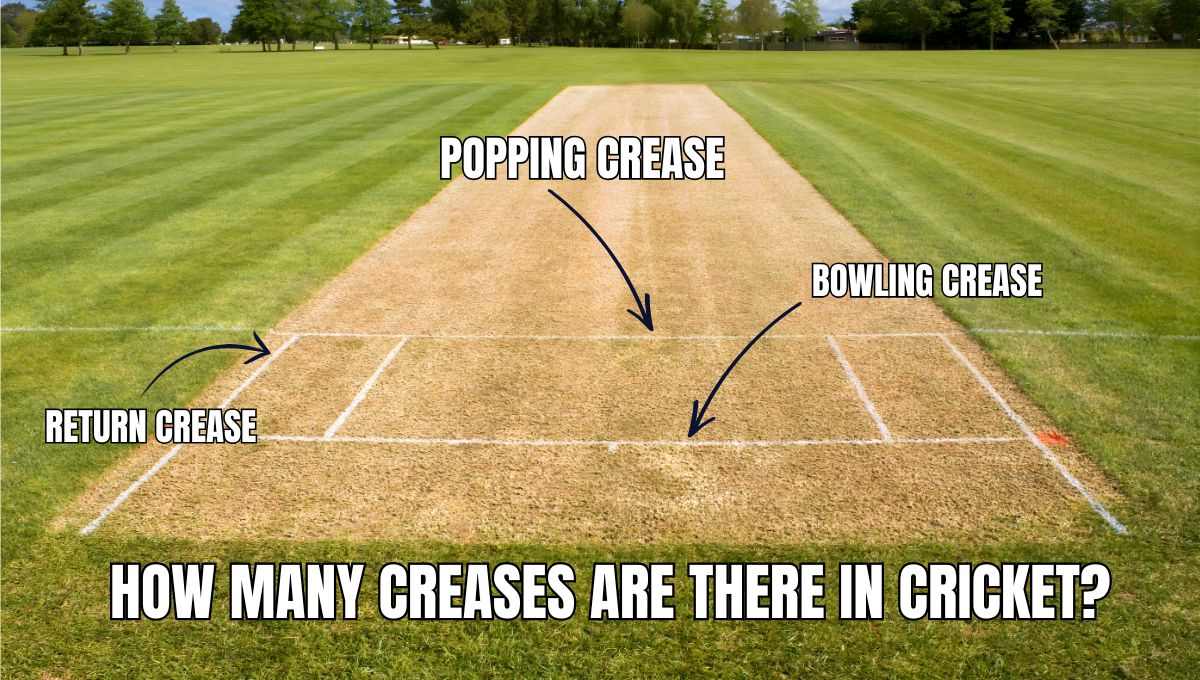
There are eight creases on a cricket pitch, four at each end. At each end there is one popping crease, one bowling crease and two return creases. Multiplying that out gives two popping creases, two bowling creases and four return creases on the entire pitch, which holds true for every match played, from Ranji Trophy game to World Cup final. If eight cricket creases sounds like a lot more lines than you remember seeing behind the wickets when you watch a game on TV, consider this: The only time most broadcasters highlight any crease on the pitch is when they show a run out replay and the runner has jumped over the popping crease. The other creases on the field see plenty of action too. They’re just not as exciting. In this article you will find out exactly how Many Creases Are There in Cricket?
What Exactly Is a Crease in Cricket?
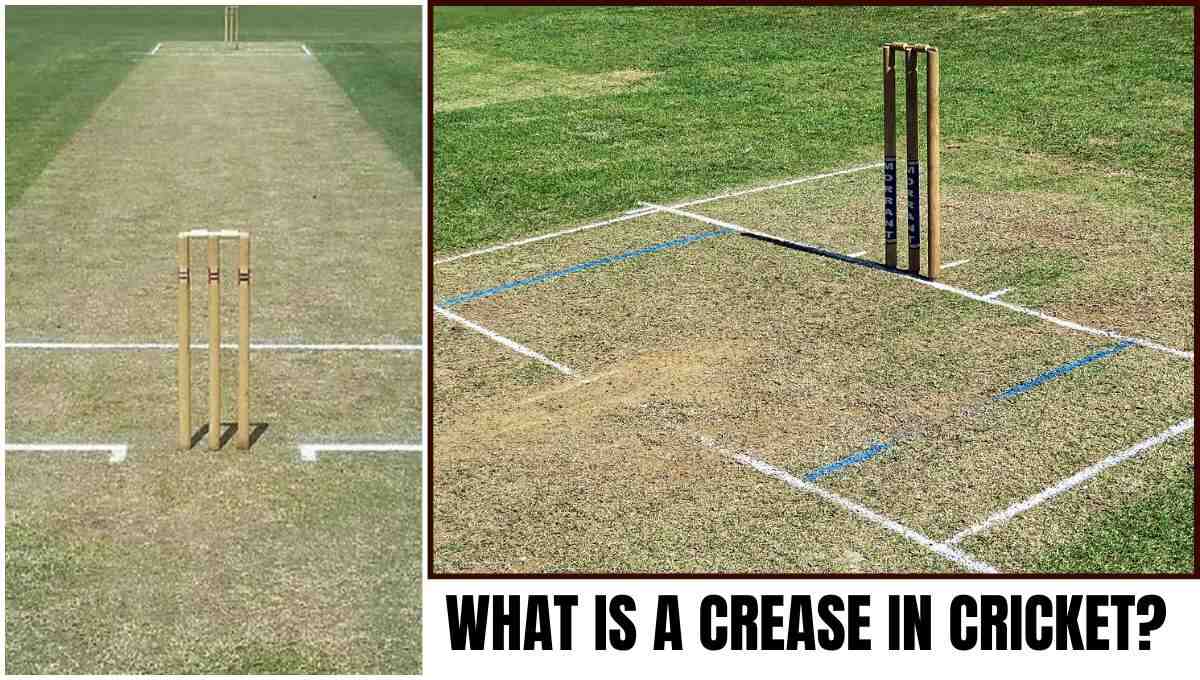
A crease is a chalked white line drawn on the field of play that indicates a legal or safe position for players. They’re not there to look nice — each crease has been placed on the field so it can be used to answer a question while the game is played:
- Is the batter safe in their ground, or can they be run out?
- Did the bowler’s front foot arrive in time, or was it a no-ball?
- Did the bowler’s back foot overstep the return crease?
Without them, umpires would have no stationary points of reference from which to make decisions on dismissals and illegal deliveries, and we wouldn’t have reviews for run outs, stumpings, and no-balls.
How Many Creases Are There in Cricket?
In total there are 8 creases in cricket, 2 popping creases (1 at each end), 2 bowling creases (1 at each end) and 4 return creases (2 per end). Here’s a quick breakdown
| Crease Type | Count | Position | What It Governs |
|---|---|---|---|
| Popping Crease | 2 (1 per end) | 1.22 m (4 ft) in front of the stumps | Run-outs, stumpings, front-foot no-balls |
| Bowling Crease | 2 (1 per end) | In line with and touching the stumps | Marks where the stumps are pitched |
| Return Crease | 4 (2 per end) | 1.32 m either side of the middle stump, perpendicular to the popping crease | Back-foot no-balls, wide-ball calls |
Counting them (2 + 2 + 4) in total makes eight creases altogether. The official cricket rule book (known as the Laws of Cricket), which is compiled by the Marylebone Cricket Club (MCC) and now policed globally by the ICC recognises three categories of crease, not eight separate ones – which explains some of the online confusion. Three sets of creases repeated at each end equals eight lines on the ground.
The 3 Types of Creases, Explained
1. Popping Crease
Popping crease is arguably the line most bowlers and batsmen interact with. It’s probably also the line that springs to mind when most people think about cricket creases.
- Drawn 1.22 metres (4 feet) from the stumps towards the bowler, parallel to the bowling crease.
- A batter can only be given run out or stumped if their bat or any part of their body is behind this line and on the ground.
- If a bowler’s front foot is completely over this line at the instant of delivery, they will be given out front-foot no-ball.
- In limited-overs cricket, a no-ball also rewards the batting team a free hit on the next delivery.
Its length isn’t specified by the Laws — they only demand it stretches at least 1.83 m (6 feet) to either side of the imaginary line connecting the middle stumps — however it’s traditionally marked out far beyond that distance.
2. Bowling Crease
The bowling crease is the line the stumps are placed on. It remains static during the game and isn’t used as a reference point to determine whether the bowler’s foot is placed behind or ahead of it (like the popping crease does).
- It runs along the base of the three stumps at either end of the pitch.
- It measures 2.64 metres (8ft 8in) long and is centred around the stumps.
- The bowling crease supports the other creases by marking the position of the stumps exactly and serving as the anchor for the location of the return creases.
Since the bowling crease plays the least role in directly calling no-balls, it attracts the least attention of all three creases. However, without it, there would be no fixed point of reference for the stumps and no guarantee that the other creases would be placed consistently relative to them.
3. Return Crease
Return crease is the one crease that is probably missed by most spectators when viewing cricket. It is just as important as the popping crease for being a legal delivery.
- There are two return creases, one on either side of the stumps, totalling four at an end.
- They are perpendicular to the popping and bowling creases.
- They are located 1.32 metres (approximately 4 ft 4 in) away from the centreline drawn through the middle stump.
- According to the Laws, they extend at least 2.44 m behind the popping crease, and extend unlimited behind that point.
- The bowler’s back foot must be within (or on) the return crease when delivering the ball. If not, it is called a no-ball and can be considered a wide in some cases.
Umpires also use them to determine if a bowler consistently runs onto the protected area of the pitch; if so, the bowler may be warned or punished according to the Laws.
Why 8 Creases Instead of “3”?
Most people get confused while searching for this answer. There are officially three kinds of crease in cricket: popping, bowling, and return. However, since the pitch has two ends, each crease is marked out twice. Therefore:
- 1 popping crease x 2 ends = 2
- 1 bowling crease x 2 ends = 2
- 2 return creases x 2 ends = 4
Add them all together and you get 8 total creases.
This holds true whether you’re at Lord’s watching a Test match or in your backyard playing for your local cricket club. The Laws are standard everywhere from club cricket to international level.
How Creases Decide Real Match Moments
You might know these facts about the crease from rulebooks, trivia quizzes or close matches gone viral, but these obscure lines have actually determined the outcomes of matches:
- Run-outs by inches. Close matches are often won or lost based on whether the bat crossed the popping crease before the stumps were knocked over or not. The world cup semifinal between India and New Zealand in 2019 is a great example where MS Dhoni got run out in the final moments of a match in a thrilling run chase and India lost the match and got knocked out of the tournament.
- Wickets overturned by no-balls. A bowler can bowl what seems like a wicket-taking delivery only to have it turned into a no-ball by replays showing that their front landed just a millimetre past the popping crease. In white- ball cricket, that free hit can cost the team that bowled the no-ball the match.
- Stumpings in white-ball cricket. Wicketkeepers use the popping crease as a guide when whipping off the bails the moment a batter’s foot is outside their crease.
It’s moments like these that make broadcasters show ball-tracking lines and crease markings on TV during games, one crease call can make the difference between winning and losing.
Final Thoughts
So, how many creases are there in cricket? There are 8 creases on every cricket pitch irrespective of whether it is an international match or a club level match, 2 popping creases, 2 bowling creases, and 4 return creases, with one set of all four at each end of the cricket pitch. Creases are split into 3 categories by the Laws of Cricket, but since there are two ends on a cricket pitch the physical number doubles to 8. Now next time there is a run- out review or no-ball being debated with the third umpire you’ll know exactly what line (and how many inches) it comes down to.
FAQs
A1. There are 8 creases in total. At each end, there is 1 popping crease and 1 bowling crease. There are also 2 return creases at each end.
A2. There are 4 creases at each end of a cricket pitch. There is 1 popping crease, 1 bowling crease and 2 return creases at each end.
A3. The popping crease should be 1.22 meters (4 feet) away from the stumps at each end.
A4. The bowling would be called front- foot no- ball. The batting team earns one extra run, and in limited-overs cricket, the next ball becomes a free hit.
A5. The delivery would be called a no-ball (the bowler could also be adjudged to have bowled a wide, depending upon where they delivered the ball).
A6. No. The crease sizes and rules are the same across all formats of cricket. Test matches, One Day Internationals, Twenty20s and even franchise leagues play by the same Laws of Cricket when it comes to crease dimensions and markings.
A7. The Laws of Cricket state the rules and sizes for creases on a cricket field. The custodian of the Laws is the Marylebone Cricket Club (MCC). The body that polices the Laws in international cricket is the International Cricket Council (ICC).
Also Read: Smaran Ravichandran: Age, Height, Career, Stats, Net Worth, Social Media